What this topic answers
How should a local campaign turn supporter identification into actual turnout?
Campaign Intelligence
Research-backed turnout guidance for final-week planning, Election Day execution, reminder sequencing, and calmer late-cycle volunteer coordination.
What this topic answers
How should a local campaign turn supporter identification into actual turnout?
Best first read
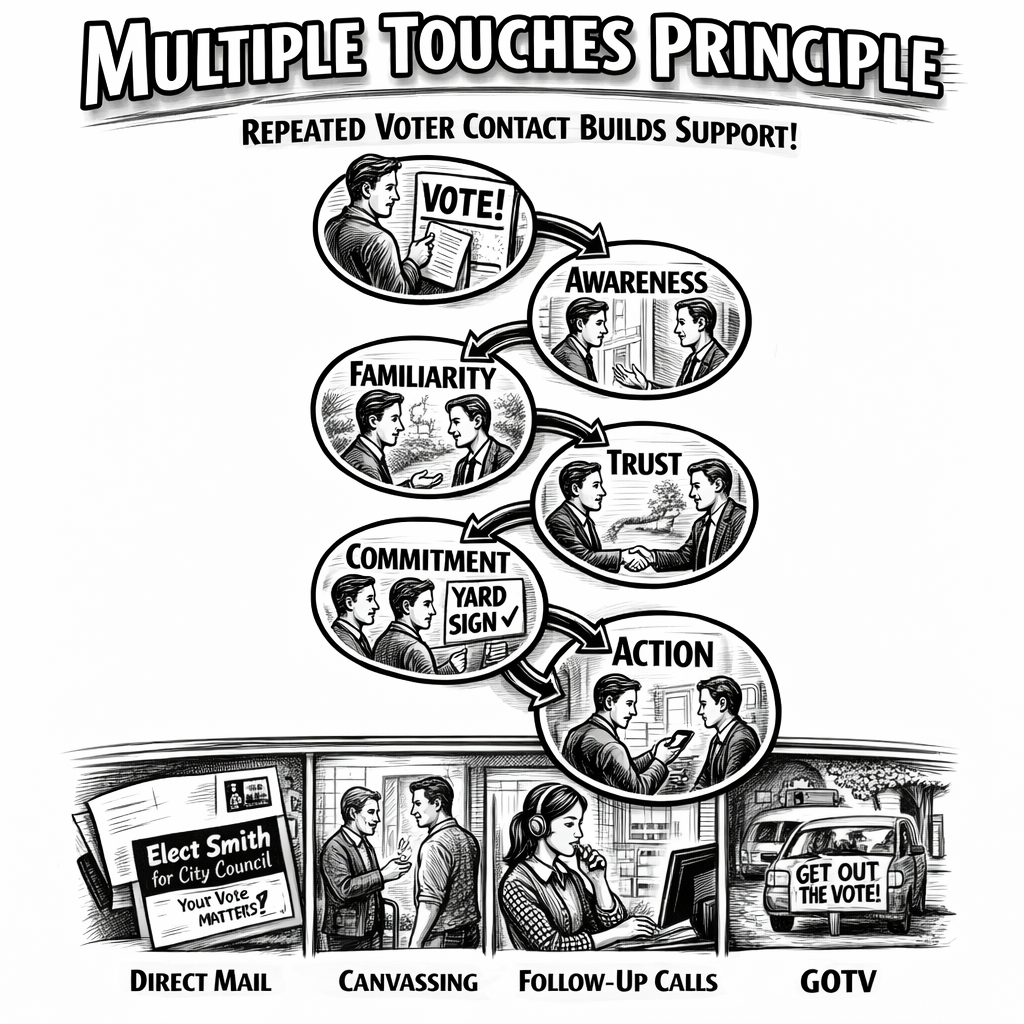
The "Multiple Touches" Principle
Read FirstRecommended workflow
GOTV Software
Explore GOTVStart Here
Start with the analysis that gives you the clearest strategic frame before you move into the rest of this topic library.
Strategy Guide
2026-06-07Repeated voter contact works because people move through awareness, familiarity, trust, commitment, and action. Local campaigns can use that pattern to combine mail, canvassing, follow-up, and GOTV into one stronger outreach system.
Local campaigns should sequence touches intentionally so each contact builds on the last and prepares the voter for the next step in the relationship.
Read FirstGOTV Guide
A relationship-driven GOTV plan starts early, uses canvassing to organize the campaign, and turns repeated voter contact into turnout on Election Day.
GOTV Guide
The strongest GOTV plans start months before Election Day and use volunteer networks, voter identification, and repeated personal contact to move supporters from agreement to action.
Volunteer Management Guide
House parties are one of the strongest ways to turn neighborhood trust into volunteer growth, community ownership, and the personal relationships that drive turnout.
Research Review
Winning local campaigns grow by identifying trusted voices, building neighborhood relationships, and turning those relationships into volunteer leadership and turnout momentum.
Research Review
House parties help local campaigns turn existing neighborhood trust into volunteer recruitment, stronger community relationships, and a wider network of campaign supporters.
GOTV Guide
Phone canvassing works best when campaigns use it to extend trusted relationships, recruit volunteers, and move known supporters toward a voting plan.
Research Review
Local elections are often won by candidates who use direct door-to-door conversations to build trust, learn from voters, and convert low-turnout conditions into a turnout advantage.
School Board Campaign Guide
Open school board seats are won by candidates who listen early, learn directly from the community, and build trust through repeated door-to-door conversations.
GOTV Guide
The strongest campaigns treat GOTV as an integrated system that starts months before Election Day and connects supporter identification, volunteer growth, personal contact, and turnout execution.
When you are ready to move from strategy into execution, these software pages show how brb Campaigns helps organize the work.
Start Here
See the full campaign workspace that keeps planning, outreach, volunteers, and follow-up in one place.
See this in the brb Campaigns AppField Execution
Turn voter targeting into door plans, packets, field shifts, and clearer follow-up after every conversation.
Explore Door CanvassingVoter Contact
Organize voter targeting, outreach, and follow-up so your team stays focused on the voters who matter most.
Explore Voter OutreachTurnout Planning
Best fit for this topicBuild a calmer turnout plan for final-week outreach, volunteer assignments, and Election Day execution.
Explore GOTVTeam Organization
Organize volunteer roles, staffing visibility, and follow-up so supporter energy turns into useful campaign work.
Explore Volunteer ManagementLocal Race Fit
See practical workflows for school board candidates who need local outreach, volunteer support, and turnout planning.
Explore School Board Workflows