Phone Outreach

Phone canvassing works best when campaigns use it to extend trusted relationships, recruit volunteers, and move known supporters toward a voting plan.

GOTV GuideBy Alan Gerber, Melissa R. Michelson, and David W. Nickerson2026-06-14

Core idea

Phone canvassing is most effective when it extends real relationships and reinforces earlier campaign contact instead of trying to replace it.

Best use

The strongest phone programs identify supporters, recruit volunteers, invite event participation, and confirm a voting plan as part of a larger turnout system.

What wins

Campaigns get more value from authentic follow-up conversations than from high-volume calling alone, especially when volunteer phone banks connect to canvassing and GOTV work.

Phone Canvassing: Turning Conversations Into Votes

Successful campaigns are built on relationships.
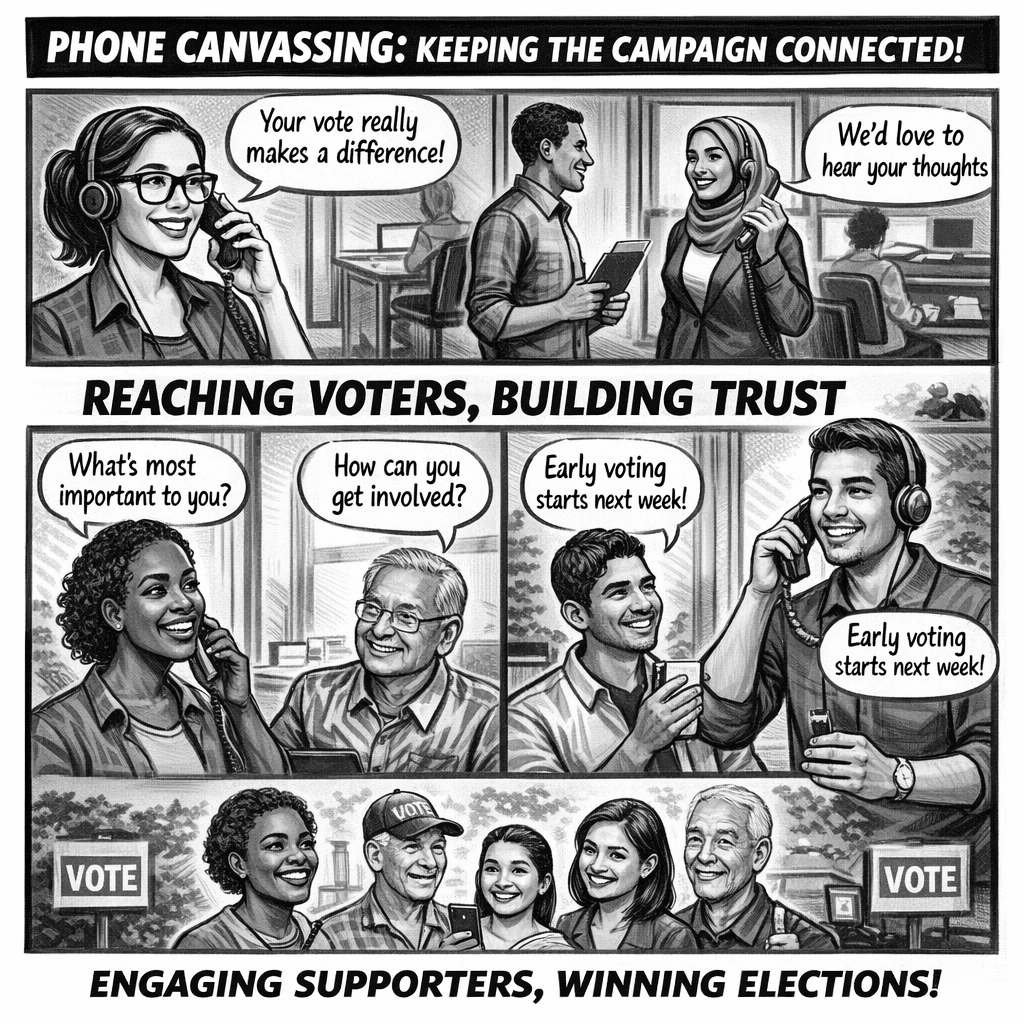
Campaign volunteer making a phone canvassing call while tracking voter follow-up and turnout outreach.

Every conversation with a voter is an opportunity to strengthen trust, learn what matters most to the community, and help supporters take the next step toward participation. While door canvassing creates powerful face-to-face connections, phone canvassing allows campaigns to continue those conversations at scale and maintain momentum throughout the election.

The most effective campaigns do not rely on a single voter contact. They create a coordinated system of outreach that builds familiarity, trust, and commitment over time.

Research consistently shows that personal voter contact is one of the most effective methods of increasing turnout. Door-to-door conversations remain the gold standard, while well-executed volunteer phone banks can significantly increase participation when they focus on authentic conversations and meaningful follow-up. The strongest results occur when phone banking is integrated into a broader voter engagement strategy.

Why Phone Canvassing Matters

A phone call creates an opportunity to reconnect with voters after an initial conversation. A voter may have met the candidate at a house party. A volunteer may have spoken with them at the front door. They may have attended a community event or requested campaign information. Phone canvassing keeps that relationship moving forward.

Each call reinforces a simple but powerful message: "We remember you." "We listened." "We care about your concerns." The cumulative effect of these interactions is trust, and trust is one of the strongest drivers of voter participation.

The Purpose of a Phone Call

Phone canvassing works best when each conversation is designed to move the relationship forward, improve campaign knowledge, or deepen participation.

Who Should Receive Follow-Up Calls?

The strongest phone programs focus first on voters who already know the campaign in some way. These conversations are not cold introductions. They are follow-up contacts that reinforce relationships already taking shape.

The highest-value phone conversations often involve:

  • Voters who spoke with a canvasser.
  • House party attendees.
  • Community event participants.
  • Supporters who requested information.
  • Volunteers and volunteer prospects.

A follow-up call strengthens that connection and helps move people from familiarity toward participation.

Measuring Success

The strongest campaigns measure outcomes rather than activity. The most useful phone program metrics connect campaign conversations directly to voter movement and Election Day results.

The Strategic Advantage

Local campaigns are won through community relationships. Advertising can create awareness. Mail can reinforce recognition. Technology can improve organization. But conversations create trust.

Phone canvassing gives campaigns an efficient and scalable way to maintain those conversations throughout the election cycle. When combined with door canvassing, volunteer recruitment, house parties, community events, and a disciplined GOTV plan, phone banking becomes one of the most effective tools available to a local campaign.

The goal is to build relationships that become votes.

How Winning Campaigns Apply This

Winning campaigns use phone canvassing as a follow-up layer inside a larger field system, calling the voters most likely to respond to relationship-based reminders and connecting every call to volunteer growth, event participation, or a voting plan.

How BRB Campaigns Supports This

brb Campaigns helps teams manage call lists, capture support and volunteer data, track follow-up actions, and connect phone conversations to canvassing, events, and GOTV execution so no voter relationship stalls between contacts.

Related BRB workflow: Phone banking, volunteer recruitment, voter follow-up, and GOTV execution

Key Takeaways

  • Personal voter contact remains the strongest turnout tool overall, but volunteer phone programs can produce meaningful gains when they focus on authentic follow-up and targeted supporter contact.
  • Phone calls are most valuable when they strengthen relationships already created through canvassing, events, house parties, or earlier campaign contact.
  • The best campaigns measure phone banking by supporter movement, volunteer growth, event participation, voting-plan creation, and completed turnout rather than call volume alone.

Continue by topic

Strategy Guide

The "Multiple Touches" Principle

Repeated voter contact works because people move through awareness, familiarity, trust, commitment, and action. Local campaigns can use that pattern to combine mail, canvassing, follow-up, and GOTV into one stronger outreach system.

GOTV Guide

The Winning Canvassing Plan

A relationship-driven GOTV plan starts early, uses canvassing to organize the campaign, and turns repeated voter contact into turnout on Election Day.

GOTV Guide

Build a Winning GOTV Plan

The strongest GOTV plans start months before Election Day and use volunteer networks, voter identification, and repeated personal contact to move supporters from agreement to action.

Volunteer Management Guide

House Parties Win Neighborhoods

House parties are one of the strongest ways to turn neighborhood trust into volunteer growth, community ownership, and the personal relationships that drive turnout.

Research Review

Winning Communities Through Trusted Voices

Winning local campaigns grow by identifying trusted voices, building neighborhood relationships, and turning those relationships into volunteer leadership and turnout momentum.

Research Review

Turning Community Leaders Into Campaign Supporters

House parties help local campaigns turn existing neighborhood trust into volunteer recruitment, stronger community relationships, and a wider network of campaign supporters.

Research Review

Door Canvassing Wins Local Elections

Local elections are often won by candidates who use direct door-to-door conversations to build trust, learn from voters, and convert low-turnout conditions into a turnout advantage.

School Board Campaign Guide

Winning an Open School Board Seat

Open school board seats are won by candidates who listen early, learn directly from the community, and build trust through repeated door-to-door conversations.

GOTV Guide

GOTV is a System

The strongest campaigns treat GOTV as an integrated system that starts months before Election Day and connects supporter identification, volunteer growth, personal contact, and turnout execution.

Volunteer Management Guide

Volunteers Win Elections: The Hidden Power of Social Networks

Volunteer programs become stronger when campaigns build social networks that multiply recruitment, retention, and useful voter contact capacity.

Volunteer Management Guide

Campaign Volunteer Management Guide

A volunteer management guide for local campaigns that need clearer staffing, better placement, and more reliable follow-up after each shift.

Read next

Continue with the related analysis most likely to help you deepen the same campaign decision.

GOTV Guide

GOTV is a System

The strongest campaigns treat GOTV as an integrated system that starts months before Election Day and connects supporter identification, volunteer growth, personal contact, and turnout execution.

Read Next

Volunteer Management Guide

Campaign Volunteer Management Guide

A volunteer management guide for local campaigns that need clearer staffing, better placement, and more reliable follow-up after each shift.

Read Next

Turn this into action

When you are ready to act on this analysis, these software pages show the BRB workflows most relevant to the work ahead.

Political Campaign Software

See the full campaign workspace that keeps planning, outreach, volunteers, and follow-up in one place.

Recommended workflowSee this in the brb Campaigns App

Door Canvassing Software

Turn voter targeting into door plans, packets, field shifts, and clearer follow-up after every conversation.

Recommended workflowExplore Door Canvassing

Voter Outreach Software

Organize voter targeting, outreach, and follow-up so your team stays focused on the voters who matter most.

Recommended workflowExplore Voter Outreach

GOTV Software

Build a calmer turnout plan for final-week outreach, volunteer assignments, and Election Day execution.

Recommended workflowExplore GOTV

Campaign Volunteer Management

Organize volunteer roles, staffing visibility, and follow-up so supporter energy turns into useful campaign work.

Recommended workflowExplore Volunteer Management

School Board Campaign Software

See practical workflows for school board candidates who need local outreach, volunteer support, and turnout planning.

Recommended workflowExplore School Board Workflows